




When an investor gives a corporation money in return for part ownership, the corporation issues a certificate or digital record of ownership interest to the stockholder. This certificate is known as a stock certificate, capital stock, or stock. The officers of a corporation are appointed by the corporation’s board of directors to carry out (or execute) the policies established by the board of directors. The officers include the president, chief executive officer (CEO), chief operating officer (COO), chief financial officer (CFO), vice presidents, treasurer, secretary, and controller. Notice that the balance of the Income Summary account is actually the net income for the period. Revenue is the total amount of income generated by the sale of goods or services related to the company’s primary operations.
If a business sold all of its assets and used the cash to pay all liabilities, the leftover cash would equal the equity balance. When one company buys another, the purchaser buys the equity section of the balance sheet. Though cash dividends are the most common payout, remember that stock dividends are another option. Unlike cash payments, stock dividends don’t immediately impact a company’s bottom line.
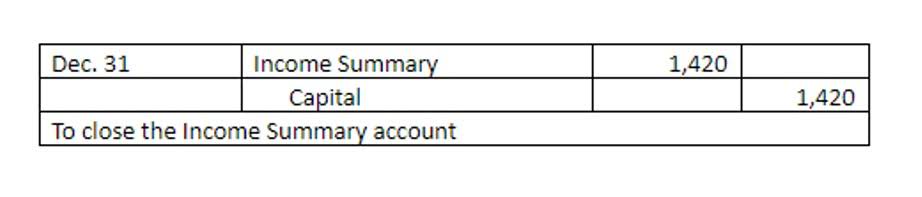
For corporations, Income Summary is closed entirely to “Retained Earnings”. To close expenses, we simply credit the expense accounts and debit Income Summary. Retained earnings (RE) are calculated by taking the beginning Bookkeeping for Chiropractors balance of RE and adding net income (or loss) and then subtracting out any dividends paid. If for instance, the company incurred losses of $100,000 the journal entry for the loss will be recorded as shown below. When companies keep a record of their transactions, they do so using the double-entry bookkeeping system.
The 2-for-1 stock split will cause the quantity of shares outstanding to double and, in the process, cause the market price to drop from $80 to $40 per share. For example, if a corporation has 100,000 shares outstanding, a 2-for-1 stock split will result in 200,000 shares outstanding. If the “loss” is larger than the credit balance, part of the “loss” is recorded in Paid-in Capital from Treasury Stock (up to the amount of the credit balance) and the remainder is debited to Retained Earnings.

It serves as a tool for internal control and provides stakeholders with a clear understanding of how retained earnings have evolved during a specific accounting period. Retained earnings are a critical component of a company’s equity, reflecting the cumulative amount of net income that has been reinvested in the business rather than distributed to shareholders as dividends. This financial measure is not only an indicator of a firm’s historical profitability but also a gauge for its potential future investments and growth capacity. The main difference between retained earnings and profits is that retained earnings subtract dividend payments from a company’s profit, whereas profits do not.
From our discussion, we have seen that retained earnings are usually a credit and not a debit. Retained earnings are the company’s net income that it keeps for future business operations instead of paying out as dividends to its shareholders. The higher a company’s retained earnings, the more financially stable it is. This indicates that the company generates adequate revenue that covers its expenses and dividend payments while still having some leftover money to reinvest in the business. Some factors that can affect a company’s retained earnings include depreciation, COGS, dividends, etc.

The balance sheet is also referred to as the Statement of Financial Position. To comply with state regulations, the par value of preferred stock is recorded in its own paid-in capital account Preferred Stock. If the corporation receives more than the par amount, the amount greater than par will be recorded in another account such as Paid-in Capital in Excess of Par – Preferred Stock. For example, if one share of 9% preferred stock having a par value of $100 is sold for $101, the following entry will be made. When it comes to dividends and liquidation, the owners of preferred stock have preferential treatment over the owners of common stock. In other words, preferred stockholders receive their dividends before the net sales common stockholders receive theirs.
Retained earnings are affected by any increases or decreases in net income and dividends paid to shareholders. As a result, any items that drive net income higher or push it lower will ultimately retained earnings debit or credit balance affect retained earnings. The total amount realized by a company from the sales of goods or services rendered is its revenue. This amount includes all income that has been generated before the deduction of expenses and it is commonly referred to as gross sale.

Leave a Reply